A Sunday afternoon on the Port Hacking River
Kalim Scharenguivel traces the first Water Makers Australia system to a Sunday spent with his father-in-law and co-founder, Stephen Tritton, on the Port Hacking River south of Sydney. Stephen needed a watermaker for his own boat. Rather than begin with a catalogue or a brand strategy, the pair began with the boat in front of them: the available spaces, the power supply, the plumbing run and the practical question of how an owner would maintain the system after the installation was finished.
That family project became the foundation of the company. The design has evolved, but the original point of view remains visible: build from the owner’s side of the engine-room hatch. For Kalim, the real product is not a production figure on a brochure. It is giving a couple, a family or a crew the freedom to stop carrying jerry cans, stop rationing every shower and stop planning a passage around the next marina tap. Read Kalim’s account of the beginning.
An Australian product, built around Australian boats
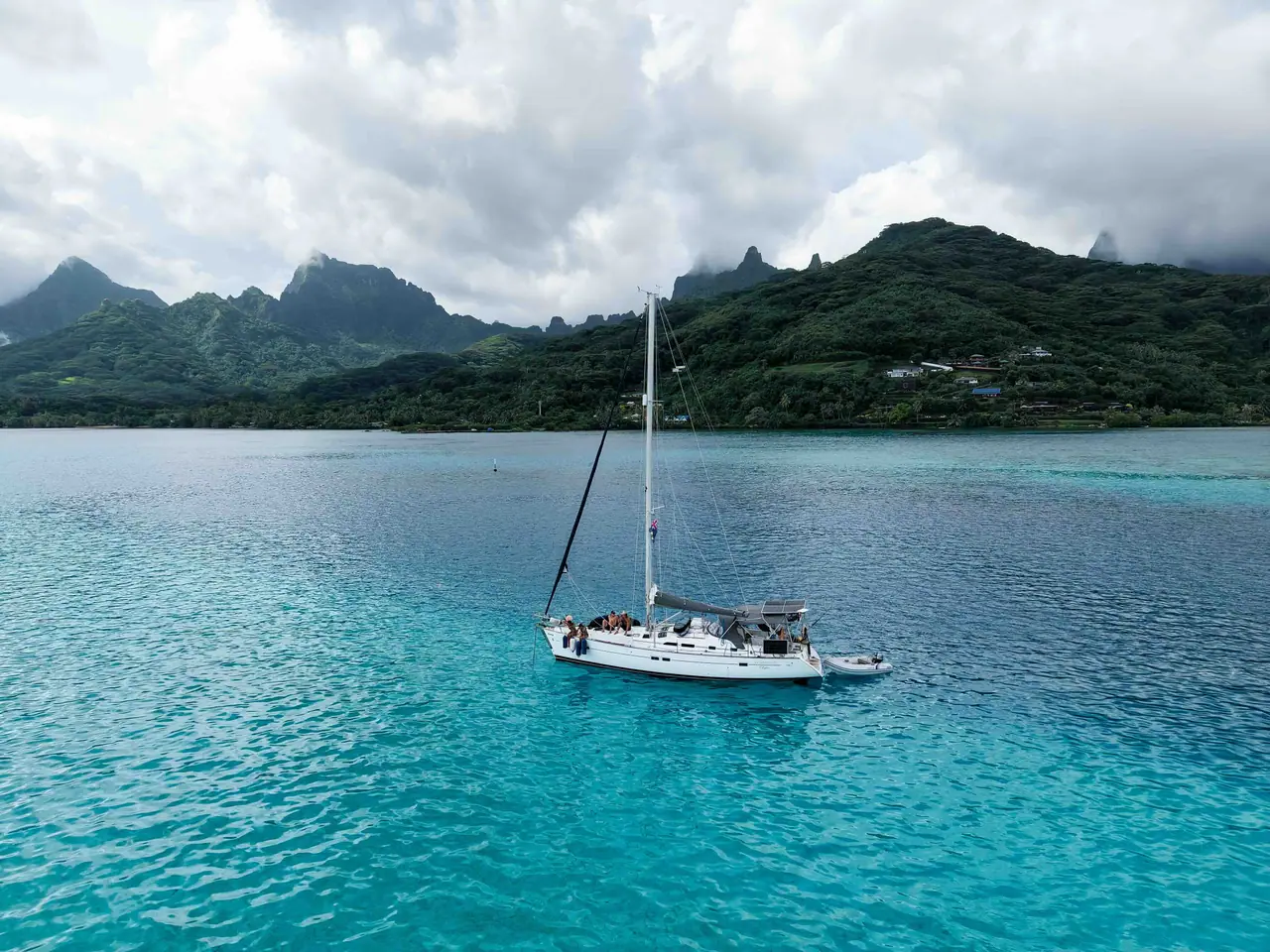
Water Makers Australia is based in Tempe, Sydney, and remains 100% Australian owned. Its local identity is not a flag added to an imported sealed appliance. The company designs and configures each system here, around the boat’s power, space, tank capacity and intended cruising. Kalim’s role stretches from sizing and sales advice to installation questions and troubleshooting after the boat has left the dock.
The components are deliberately recognisable: FilmTec seawater membranes, standard filter cartridges, serviceable fittings and established pump technology. The Australian part is the system thinking—choosing and arranging those components for harsh saltwater use, making parts obtainable and standing behind the owner seven days a week. It is a practical definition of local manufacturing: design it here, assemble and support it here, and keep it repairable wherever the boat travels.
The design idea: modular, understandable and repairable
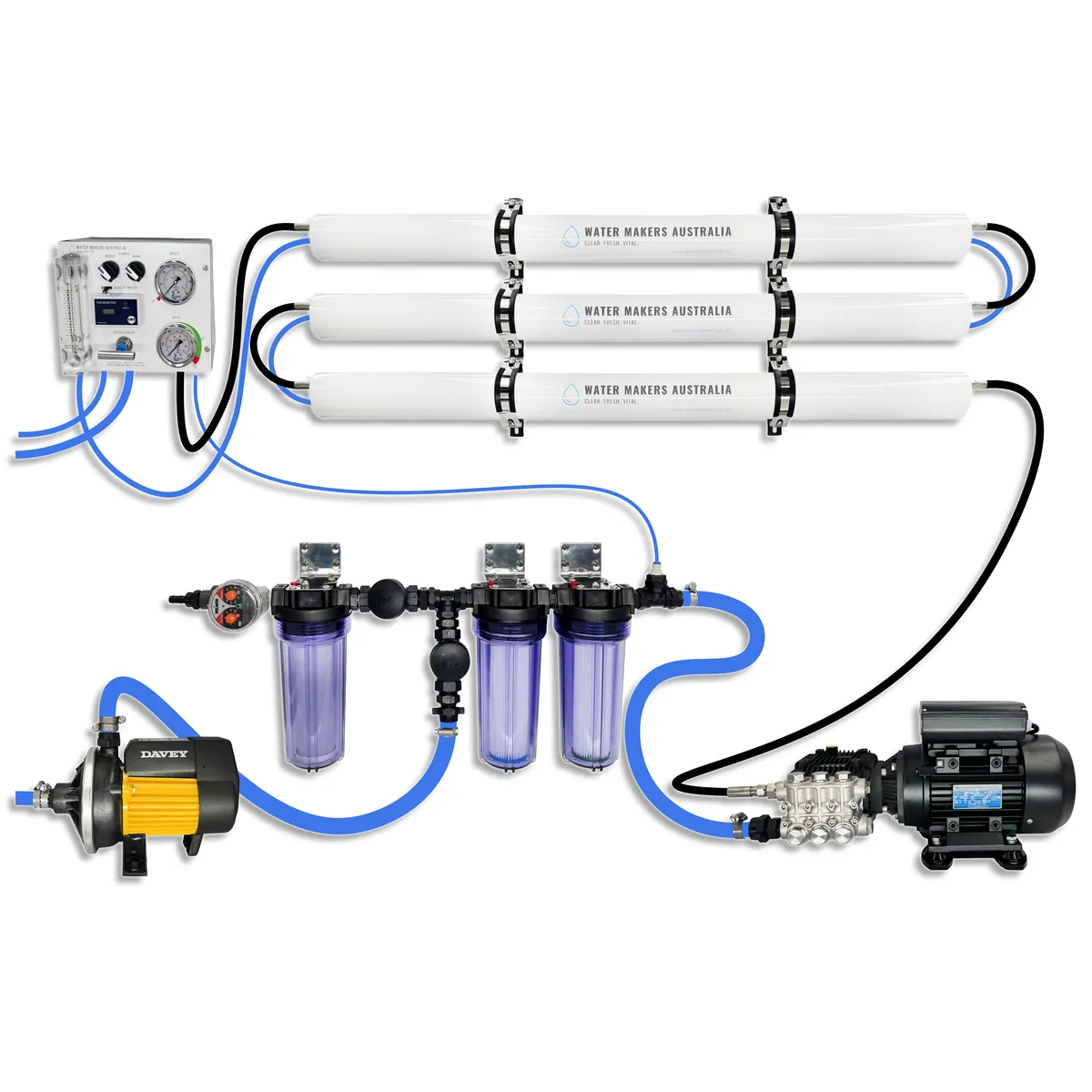
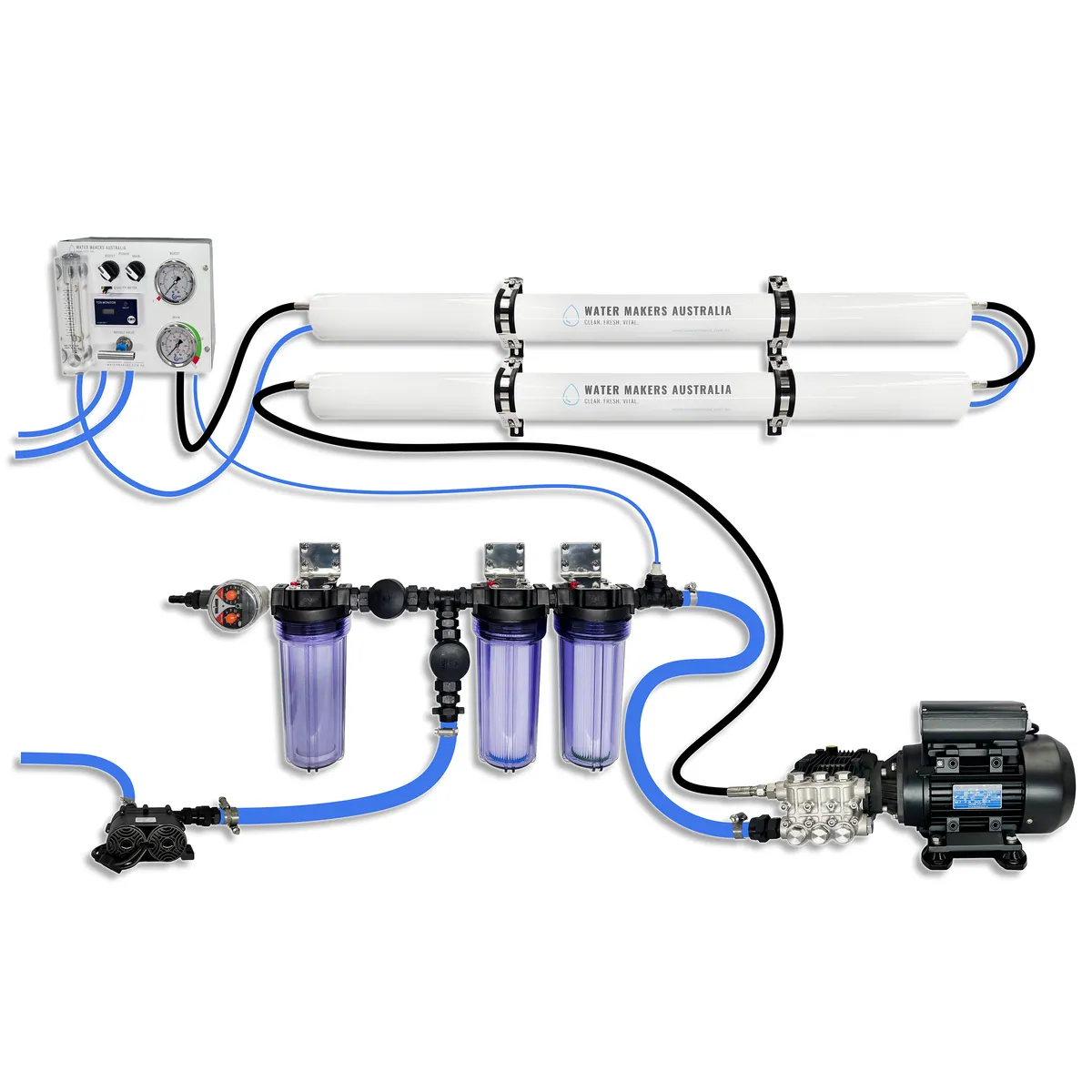
A Water Makers Australia system is deliberately modular. The control panel, pre-filters, high-pressure pump and membrane housings do not have to live inside one polished enclosure. They can be distributed through the spaces a particular yacht, catamaran or motorboat actually has. That makes installation less photogenic than a single appliance—but often much more realistic aboard a working boat.
- Standard consumables. The range uses familiar 10-inch filters and FilmTec membrane formats rather than locking routine service items behind one supplier.
- Accessible components. Pumps, filters and housings can be placed where an owner can reach them, instead of wherever a factory enclosure dictates.
- A system matched to the boat. Pump choice, output and layout are discussed against onboard power, crew demand and installation space.
- Support after delivery. Selection, installation, commissioning, operation and troubleshooting are treated as one ownership process.
The marine range: one, two or three membranes
The current marine range scales the same philosophy from single-membrane systems advertised at up to 80 L/h for couples and coastal cruising, through twin-membrane systems at up to 160 L/h for families and liveaboards, to triple-membrane systems at up to 240 L/h for expeditions and heavy use. The point is not simply to sell the largest machine. Kalim starts with daily water use, how often the owner wants to run it, available power and where the modules can physically fit.
| System | Power | Output L/hr | Draw W | Wh per litre | Price |
|---|---|---|---|---|---|
| Performance Triple 200L · 12V feed Water Makers Australianameplate estimate | AC 240V | 200 nominal | 1,610 | 8.1 | $9,181 |
| Automatic Triple 200L · AC feed Water Makers Australianameplate estimate | AC 240V | 200 nominal | 2,280 | 11.4 | $19,250 |
| Performance Double 140L · 12V feed Water Makers Australianameplate estimate | AC 240V | 140 nominal | 1,610 | 11.5 | $7,791 |
| Performance Single 80L · 12V feed Water Makers Australianameplate estimate | AC 240V | 80 nominal | 1,610 | 20.1 | $6,401 |
Our Wh/L figures are transparent nameplate estimates, not measured total running draw. We use the conservative 80, 140 and 200 L/h nominal outputs currently published under stated seawater test conditions, rather than the larger category-page maximums.
The comparison shows why model choice matters more than brand shorthand. The 200 L/h Performance Triple spreads broadly similar pump power across much more membrane area and lands at an estimated 8.1 Wh/L. The 80 L/h Performance Single uses the same published 1.5 kW motor rating and therefore lands at 20.1 Wh/L. A generator-equipped motor yacht and a solar-dependent sailing boat may rationally choose different ends of that range.
A product proven beyond the brochure
A 2026 Davey case study provides a useful view of the product in service. Water Makers Australia supplied a double-membrane system producing up to 160 L/h for a Silverton 38 Convertible refitted at Sanctuary Cove for extended Great Barrier Reef trips. The modular equipment had to fit around an already crowded flybridge motorboat, and its job was simple to describe but demanding in practice: keep a 375-litre tank full enough that the crew could plan around weather and fishing rather than marina refills.
At the feed stage was a Davey XF171S—the pump Kalim says has gone into every Water Makers Australia 240V system since 2020. Behind it sat two seawater membranes, timed automatic freshwater flushing and a remote panel with pressure, flow and water-quality instruments. Davey reports that the system could refill the vessel’s tank in under two and a half hours at full production after more than a year of reef trips. Read the independent Davey case study.
The owner is still the support desk
Kalim says he handles much of the technical support and sales advice himself. That is unusually personal for equipment that may be installed in a difficult corner of a boat hundreds of miles from the supplier. When a customer calls, the person answering is often the same person who helped decide the pump, membrane count and layout. Water Makers Australia advertises seven-day phone and email support, Australian-based guidance, readily available replacement parts and a three-year warranty on its marine systems.
The value of that approach is clearest during installation. A manual can describe where a hose belongs; it cannot see the locker, answer a commissioning question on a weekend or notice that the proposed layout will make the next filter change miserable. The repeated theme in the company’s customer feedback is not simply that the machine produced water. It is that somebody answered when the owner needed help.
What owners say after the installation
Peter A describes arriving uncertain about a DIY installation and credits Kalim with helping select the equipment and guiding the job whenever questions arose. Ian D reports installing a twin-membrane system himself, receiving help with membrane and hose installation, and seeing roughly 120–140 L/h during the first six months. Philippe Laurans similarly describes support from selection through commissioning and a detailed installation manual.
The shorter reviews reinforce the same point. Chantal Allen calls Kalim “a superstar”; Shannon Cash highlights the rarity of strong after-sales support; Ross Rynehart says communication remained responsive when a spare part was needed. Donna and Brett Gray add a valuable note of realism: their unit delivered close to its claimed output, but the Kärcher-powered configuration was demanding through an inverter and easier on their generator. That is precisely the kind of power-system arithmetic buyers should do before ordering. See the reviews published by Water Makers Australia.
From a family boat to solar water for island communities
The most consequential chapter sits beyond recreational boating. Kalim identifies autonomous solar-powered watermakers supplied to communities in Papua New Guinea and the Pacific Islands as work he is especially proud of. In that setting, serviceability is not a lifestyle preference. A system may be producing drinking water for people with no grid supply and no easy route to a proprietary replacement part.
That changes the emotional scale of the original Port Hacking experiment without changing its logic. Start with the people who will depend on the water. Understand the available energy and source water. Use components that can be maintained. Explain the machine. Stay available after it starts running. The same principles that make a sensible cruising-boat installation also matter when the machine becomes community infrastructure.
An Australian company built around availability
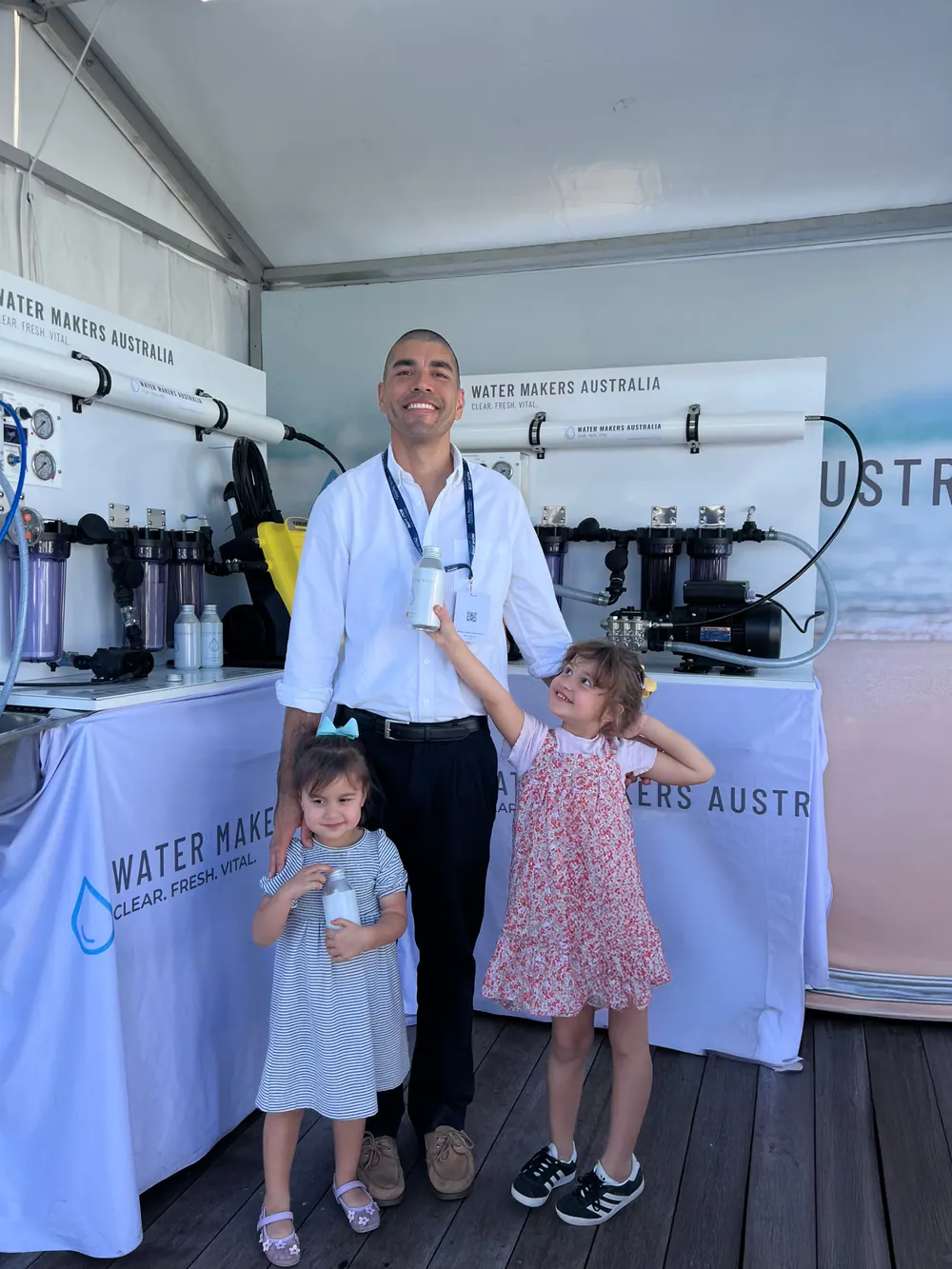
There is an appealing circularity to Kalim Scharenguivel’s story. The company began with family, on a river, solving the freshwater constraint of one boat. Today he stands at boat shows with his daughters beside him, surrounded by the machines that grew from that Sunday project. The Tempe workshop now supplies boats across Australia and supports owners overseas, but Kalim still describes the reason for doing it in personal terms: providing for his family, getting them near the water and helping other families stay out there longer.